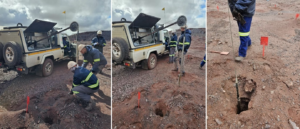
Drill Bit Diameter vs. Effective in-field Diameter
A POTENTIAL REASON FOR ADVERSE BLASTING OUTCOMES? INTRODUCTION A critical design parameter that needs to be selected during the drilling and blasting design process is

Mine A Operations | Blast Engineering & Regulatory Compliance
Abstract — Blasting in sensitive environments demands a fundamentally different approach
compared to conventional open-pit operations. This article focuses on blasting in sensitive areas
and highlights the bespoke structured design process applied, the full blast project lifecycle
(pre-blast site assessment through to post-blast reporting). Emphasis is placed on peak particle
velocity (PPV) prediction, attenuation law selection, QA/QC, seismograph deployment, and
stakeholder communication, all of which are essential to maintaining regulatory compliance and
community confidence.
Drilling and blasting remain the most technically efficient and cost-effective method for primary rock
fragmentation in both mining and civil construction. However, when blast sites are in proximity to
residential infrastructure, heritage structures, utility networks, or environmentally sensitive
receptors, the potential for vibration-induced damage and community impact becomes a primary
design constraint rather than a secondary consideration.
The bespoke approach in this paper was derived from the continued work done at one of ERG
Industrial’s clients in South Africa and will be referred to as Mine A. The drill and blast operation is
executed as a joint effort between ERG Industrial specialist engineers in collaboration with the
mining and drilling contractors on site.
ERG Industrial was approached by Mine A to assist with specialist third-party audits, QA/QC, blast design, and blast impact modelling due to the proximity of communities and infrastructure. Because the blast blocks are in proximity to community structures and other established infrastructure, continuous seismograph monitoring was established at seven key designated locations.
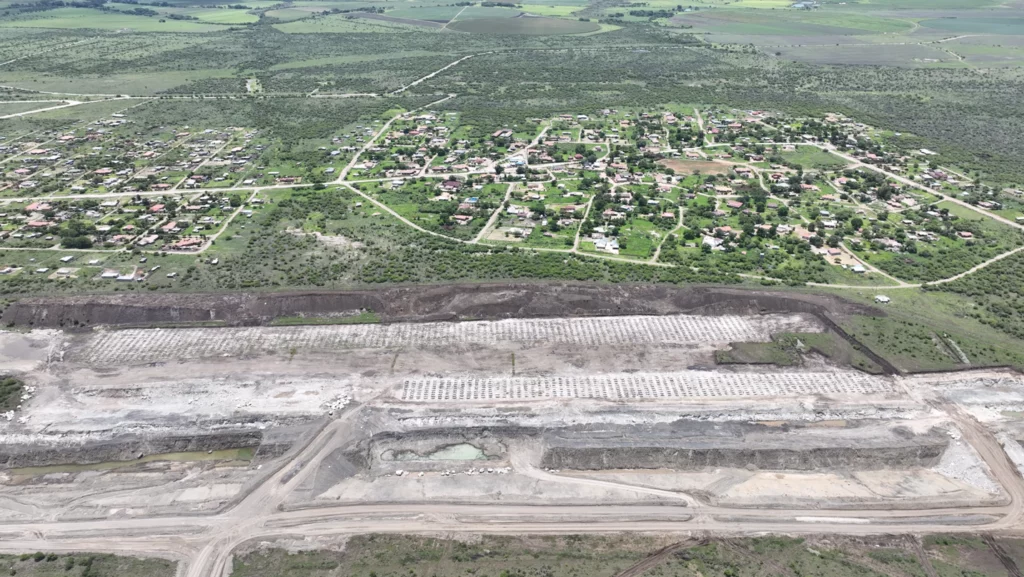
The design philosophy therefore centres on post-blast performance, continuous monitoring data, and QA/QC to ensure ensuing blast induced impacts (such as ground vibration, noise, and air overpressure/airblast) are mitigated and maintained below respective legal limits. ERG Industrial also actively assist the teams on site to balance design and execution activities to not only achieve legally compliant blasts but improved fragmentation outcomes required for downstream processing. A consolidated technical overview of the sensitive blasting process is shared along with the structured engineering approach followed to achieve successful and legally compliant blasts in sensitive areas.
Blasting activities produce blast-induced impacts and therefore require monitoring to measure such
impacts. Blasts should be monitored regardless of where blasting takes place as this has become a
legal requirement for all sites based on the mandatory code of practice (MCOP) published by the
Department of Mineral and Petroleum Resources (DMPR) in August 2024. The guidelines for the
MCOP requires all sites to have a code of practice to ensure an active blast monitoring process is in
place to optimise blasting and mitigate blast induced impacts. There is however a distinct difference
in approach when an area is classed as a sensitive blasting area due to additional requirements to
ensure legal compliance and safe blasting practices. A blasting environment is classed as sensitive
when one or more of the following conditions are met:
For Mine A, all seven seismograph monitoring locations surrounding each blast block serve as the
primary sensitive receptors. All blast designs must demonstrate (through PPV, noise and air
overpressure prediction modelling) that blast induced impacts at each location will remain within the
prescribed legal limits before a blast plan is approved for execution. ERG Industrial’s approach to
achieve this is to model various blast design options (usually three designs) to not only investigate
potential blast induced impacts but to also review the best economically viable option that still
meets the sensitivity requirements.
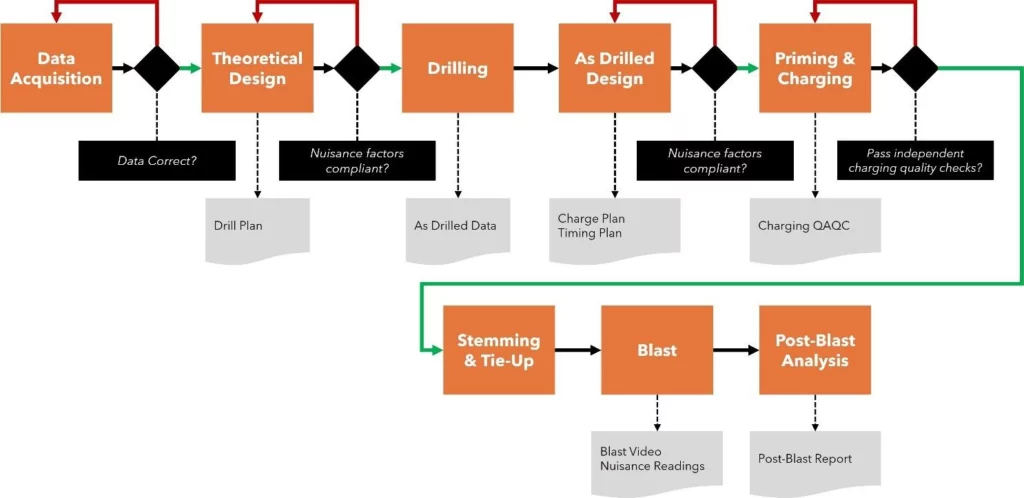
The pre-blast phase is the most consequential stage of any sensitive-area blast programme.
Decisions made during this phase determine the viability of the blast, the compliance position
relative to DMPR regulation, and the structural integrity of neighbouring infrastructure. This is also
where the economic viability is established before a survey note is developed and signed off for
drilling execution.
The design process at Mine A begins with the receipt and verification of a defined set of spatial and geotechnical input files:
| Input file | Purpose & verification requirement |
|---|---|
| Topographic drone survey | Establishes bench geometry; must align with polygon boundaries confirmed by the survey team. |
| Test hole data (if drilling touch of reef (TOR) instead of fixed elevation) | Provides maximum hole depths for modelling of blast induced impacts. |
| Reef layer data | Shared when applicable; informs drill pattern optimisation around reef contacts. |
| Blast polygon | Defines the blasting boundary wherein blastholes can be populated. A review is done and then sent to survey for spatial confirmation before design proceeds. |
| Blast radius plan | Must reflect all seven seismograph locations and their measured distances from the blast polygon. |
This verification step is non-negotiable. Proceeding with an incorrect polygon or mismatched topography introduces systematic error into all downstream predictions and affects the quality of blast pattern positioning.
Prior to any blast design work, a structural survey of all critical surface and underground infrastructure within the blast influence radius should be conducted and formally documented. This pre-blast inspection establishes a baseline condition record that serves multiple purposes:
Survey records should include photographic evidence, crack gauge readings where applicable, and a written condition assessment for each inspected structure. These records are retained for the project duration and form part of the final post-blast report.
In the case of Mine A, a third-party Civil Engineering consultant conducted a structural survey with an analysis report. The structural report was done on two stands and included a review of the structures present on the stands. The report also included a post-blast report comparing the pre-blast inspections and post-blast condition of the structures after the inaugural blasts were taken at Mine A.
All blast designs must be benchmarked against applicable regulatory limits for ground vibration and noise. These thresholds vary by structure classification: Residential structures, industrial buildings, heritage sites, and subsurface infrastructure each carry different PPV and noise limits.
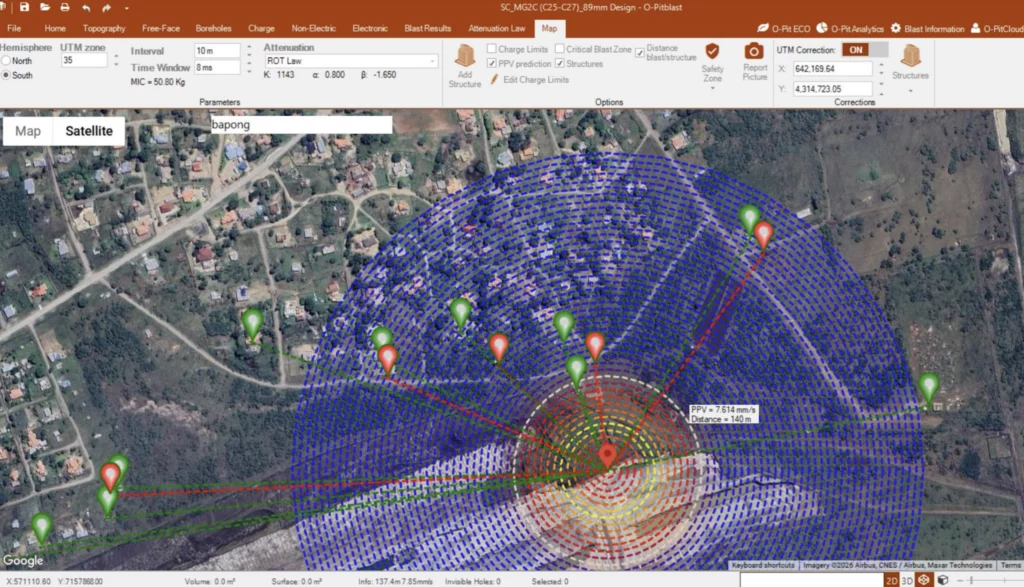
For Mine A’s project, the design process employs two independent attenuation laws within the O-Pitblast blast design software used to predict PPV levels at each monitoring station:
PPV prediction is done on the blast design software O-Pitblast indicates PPV rings spaced at 10m intervals emanating from the blast point selected. These rings provide the predicted PPV values based on each distance interval using the selected attenuation law. ERG Industrial engineers then process the PPV predictions and use this as the evidence to support the predicted values interpolated for each monitoring position identified on the blast radius plan.
Establishing a proactive communication plan with potentially affected stakeholders is a prerequisite to blasting in sensitive environments. For Mine A, the communication protocol involves a defined distribution group with representatives from the Mine owner, contractors, third-party consultants, and the community. All reports, timing CSVs, and design submissions are addressed to the site manager with full copy distribution to all designated contacts. These documents are reviewed and signed off by representatives from the various stakeholders involved.
Broader community engagements should, where applicable, clearly explain the blast schedule, expected sensory impacts (vibration, noise), the monitoring programme in place, and the mechanism for lodging a concern or complaint. Effective and transparent communication allows for the mitigation of potential escalated social or community risks as well as any legal or regulatory risk.
The theoretical design phase in O-Pitblast follows a structured, multi-step workflow applied across three diameter configurations (typically 89mm, 102mm and 115mm) to allow a comparative risk and cost assessment before a final design is selected:
Upon completion of all three design iterations, the preferred option is selected based on a structured risk assessment approach that considers flyrock potential (using Scaled depth of Burial), predicted PPV levels at all seven monitoring stations, air overpressure estimates (based on noise predictions), proximity to critical structures, economic factors (drilling cost, turnaround time and fragmentation), and performance history in comparable blast locations on site.
The Theoretical Design Report, including design parameter sheets, PPV modelling outputs, noise (air-blast) prediction results, and annotated schematics, is then submitted for internal review prior to site distribution whereafter approved reports are submitted to the client.
A robust instrumentation plan is fundamental to sensitive-area blasting. Monitoring serves three distinct functions: pre-blast baseline establishment, real-time compliance verification during the blast event, and post-blast performance analysis (Del Bosco, 2021). The objective of the guideline for the MCOP for blast monitoring, gazetted by the DMPR on 2 August 2024, is to “provide a framework with minimum standards for the employers at every mine to consider when compiling a COP to protect surface structures against impacts of ground vibration, noise, air-blast and flyrock emanating blasting operations”.
As per the DMPR MCOP guideline (NO. 5097) references 8.6.1. to 8.6.3:
At Mine A, seven fixed seismograph locations were identified as key monitoring points to ensure the surrounding structures are monitored for each blast block. These monitoring stations capture both ground vibration (expressed as PPV in mm/s) and noise (expressed in dB(L)). The monitoring plan should be supplemented as necessary with:
Prior to each blast event, all monitoring equipment must be confirmed as deployed, calibrated, and functioning correctly. Tap tests should be done to confirm the seismographs are working after placement and appropriate recording windows should be programmed based on the blast duration to ensure all relevant data is captured across the blast duration.
Seismograph placement should remain consistent across blast events to ensure that monitoring data remains comparable as the project progresses. This is also critical for the accuracy of the site-specific constants and the regression analysis for the attenuation law determination over the life of the project.
All vibration data recorded should be added to the relevant blast event’s blast pack and kept as a portfolio of evidence for blast performance review and overall project management.
The as-drilled phase represents the transition from theoretical design into an actual executed in-field design. The field-verified charging instructions and final timing design is developed using this in-field as-drilled information. The integrity of this phase is critical as any deviation between the designed and actual borehole positions or depths, if unaccounted for, will alter the effective charge per delay and ultimately adversely impact the accuracy of the predicted PPV and air-blast outcomes.
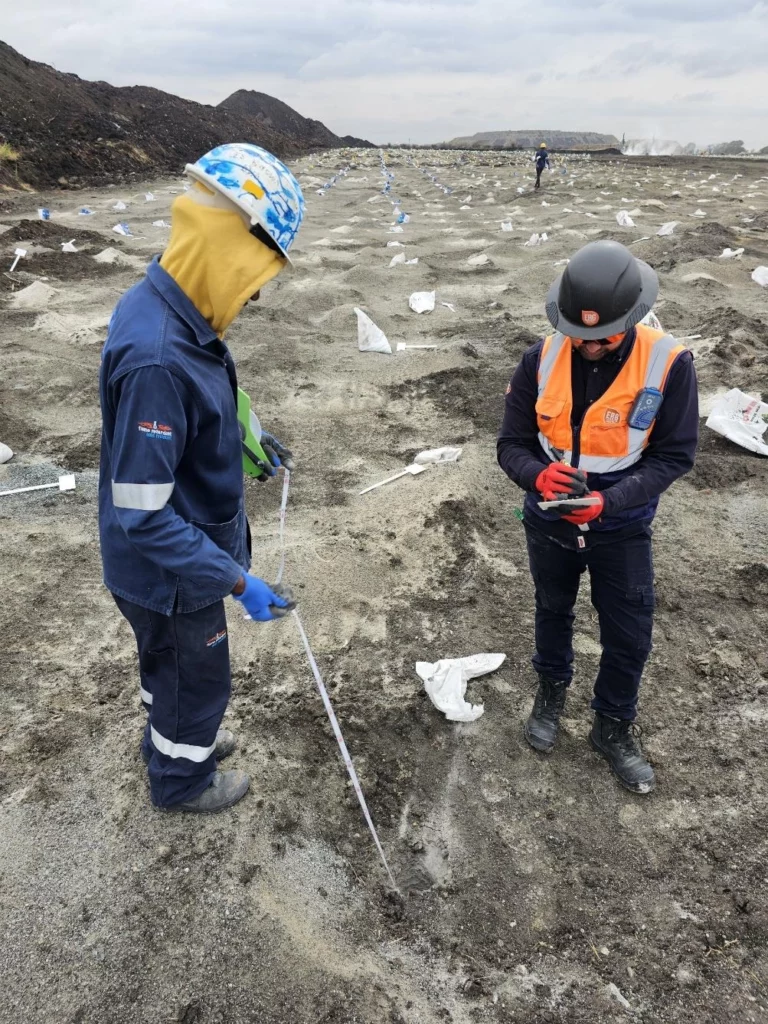
Upon completion of drilling, the following verification steps are performed before any charging instructions are issued:
The full design sequence, as described in Section 3.5, is repeated using the verified as-drilled file. A timing design is exported as a CSV and includes the Colar X,Y,Z; Hole Label and Detonation Time. Charging instructions are compiled based on the QA/QC-verified depths to ensure custom hole-specific charging to avoid overcharging as an additional risk mitigation. Additionally, a quick-reference charging table is also shared, indicating the applicable charge for a range of hole depths to ensure reliable adaptability on the day of charging should hole depths vary from the final QA/QC depths measured. The as-drilled report, charging instructions, and timing CSV are submitted for internal review, then distributed to the site team following approval.
This phase of the project is critical as this is where the final design execution takes place before blasting. Based on the charge instructions and timing designs shared, the teams on site now have to charge, stem and time the blastholes. ERG Industrial assists Mine A with additional supervision and quality control to ensure the execution is done according to plan to mitigate any potential additional risk. If, for example, a hole is overcharged, it has a higher Maximum Initiation Charge (MIC) which in turn produces an increased ground vibration and a higher risk for noise, airblast and flyrock. In sensitive blasting environments ensuring execution is accurately controlled is essential for successful and safe blasting.
This component involves both ERG Industrial engineers and blasting teams on site. The blasting team executes the charging of blastholes based on the specific charging instructions shared. These instructions followed the as-drilled design, however there may still be deviations due to external factors leading to hole collapses. All holes are measure again before the charge is applied and verified against the charge plan. If the hole depth is different from the original plan, the quick reference charging table is used to determine the new charge applicable for the hole given the new condition(s) observed.
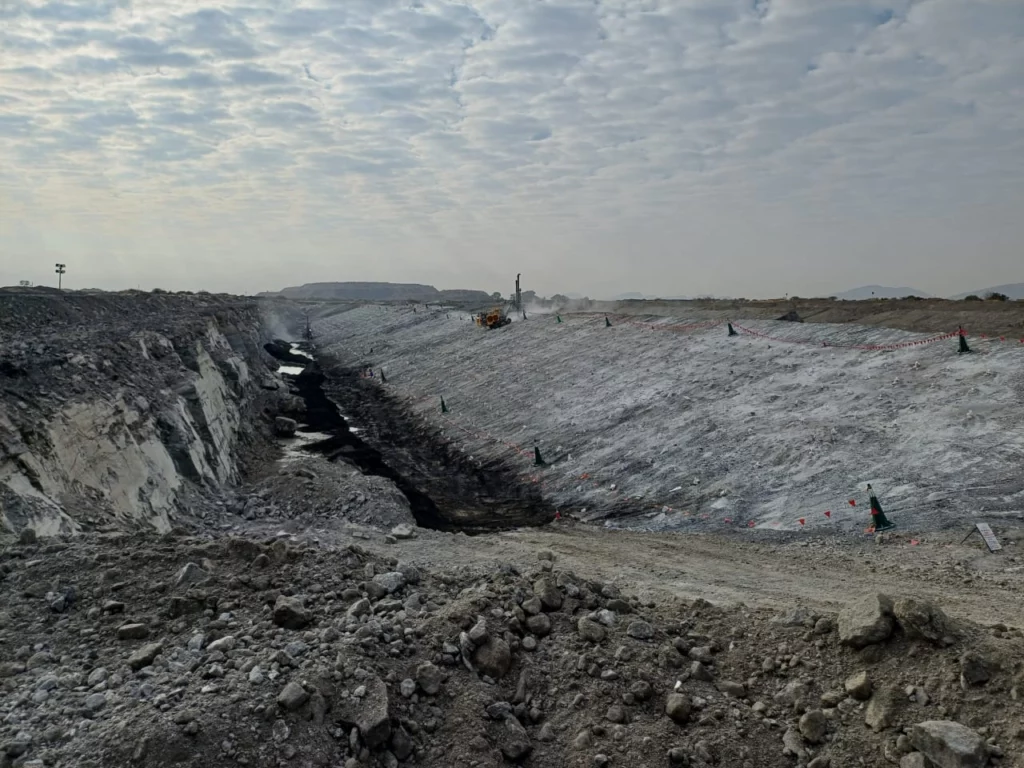
This component, similar to the charging activities, is a joint effort between the blasting team on site and ERG Industrial’s oversight. ERG Industrial engineers ensure stemming is done according to the design. Achieving the planned stemming design is crucial as this is the element that manages the quality of the blast confinement outcome. The key factors considered include:
Stemming type and quality
Correct application of stemming devices such as the Varistem® Stemming Plug
Execution of stemming of blastholes, specially if a stem loader is used. When stem loaders are used care should be given to ensure unstemmed holes are not driven over to avoid premature closure. Additionally, stemming loaders stem the holes faster than the general manual method and can potentially lead to stemming bridging challenges.
After the block is fully charged and stemmed the next key activity is to do the tie-up of the blast. The exact process of tie-up varies according to the type of initiation system used (e.g. Shock-tube/Nonel or electronics). In the case of sensitive blasting, the use of electronic initiation systems is always recommended as this allows for customisable timing and the mitigation of out-of-sequence firing due to scatter. With electronic initiation systems used at Mine A, ERG Industrial is able to customise the timing to ensure single-hole-firing (generally 8ms delay).
To ensure the MIC is kept as low as possible for reduced blast impacts, single-hole-firing is critical. ERG Industrial therefore assists the Teams on site with an overview of the timing plan logged and a final pre-blast review to ensure the risk of out-of-sequence firing or timing error is mitigated.
The day of the blast requires active field presence and systematic quality-assurance. Mine A’s process mandates that the blast engineer be on site for the pre-blast meeting (typically 08:00), the blast window (12:00–14:00), and the post-blast meeting immediately thereafter. ERG Industrial also attends these meetings to ensure alignment is maintained between all stakeholders.
The pre-blast meeting serves as the final gate before the blast. Agenda items include confirmation of the blast boundary, exclusion zone establishment, community evacuation plan, guard placement and appointments, detonation timing review, predictions review and final alignment between all stakeholders.
Following the re-entry period post-blast, the blaster reviews the block condition and inspects for any potential misfires and or other hazards before declaring the area safe for re-entry. Also noted are preliminary visual observations of block movement, muckpile shape, fragmentation quality, and any visible anomalies. All monitoring instruments are tested and confirmed to have triggered correctly, and preliminary PPV readings are noted for initial compliance assessment.
The post-blast phase is the final component in the sensitive blasting value-chain. Systematic analysis of monitoring data and visual inspection outcomes informs both compliance reporting and the iterative refinement of future blast designs.
ERG Industrial engineers to analyse the data from the seismograph monitoring locations to confirm if the maximum PPV and noise readings recorded are compliant to assigned legal limits. These results are included in the post-blast report as well as graphically compared to the predicted values from the theoretical design to quantify prediction accuracy. Over and above defining the successive of the blasts regarding compliance, this comparison informs recalibration of the site attenuation constants for improved prediction accuracy for ensuing blasts.
In the unlikely event that the blast outcomes deliver a highly deviated outcome that inflicts damage on nearby structures, there is a system in place to ensure these events are noted, inspected, and communicated to the community along with remedial actions. The process would typically look as follows:
Complaints or concerns raised by community members following a blast event are logged, as per the grievance process requirement from the DMPR noted in the MCOP.
A special task team including members from the blasting team is assembled to investigate these grievances and respond to them in accordance with the project communication plan.
Where structural response is confirmed, a formal assessment of the damage mechanism and remedial options is prepared, and remedial action plans are communicated to the community and then executed.
The consolidated post-blast report is compiled by the blast engineer, reviewed internally, and submitted to all site team members. The report contains:
This report is retained in the project management system alongside all supporting files as a portfolio of evidence. These document include the design CSVs, O-Pitblast screenshots, QA/QC data, seismograph records and any visual data of the block and the blast.
Drawing on both Mine A’s operational framework and broader industry best practice, the following factors are identified as determinative in achieving consistent, compliant outcomes in sensitive blasting environments:
| Success factor | Implementation principle |
|---|---|
| Data integrity | All input design files must be independently verified before design commences. Errors propagate through every downstream calculation. |
| Multi-design iteration | Evaluating three or more diameter configurations before selecting a final design ensures the optimal balance of fragmentation, vibration, and cost is achieved. |
| Attenuation law selection | Site-specific attenuation constants derived from historical monitoring data yield significantly more reliable PPV predictions than generic laws. |
| Timing optimisation | Single-hole firing confirmation via fixed normal delay intervals is essential to limiting effective charge per delay and controlling PPV. |
| QA/QC rigour | Charging instructions must reflect verified as-drilled depths, not theoretical values. Unverified depth data introduces charge-per-delay errors that directly affect PPV outcomes. |
| Field supervision | Physical presence of the blast engineer during charging and firing is a non-negotiable safeguard. Field conditions routinely diverge from design assumptions which can impact blast outcome quality. |
| Continuous monitoring | Appropriate seismograph coverage across key infrastructure locations enables compliance verification per blast as well as assisting with the long-term objective of accurate site-specific attenuation models. |
| Stakeholder communication | Transparent and consistent pre-blast and post-blast reporting shared with all affected stakeholders not only ensures compliance to the stakeholder engagement plan and legal requirements, but also assists in fostering good relationships between the stakeholders. This sustains the project viability not just from a technical point of view but also from a socially acceptable perspective. |
Blasting in sensitive areas cannot be simplified as a mere reduction in explosive charge. It demands a disciplined and structured approach applied consistently across the entire project lifecycle, from the initial receipt and verification of site data through to post-blast reporting and design refinement. The Mine A programme exemplifies this approach, integrating PPV prediction modelling, multi-diameter design comparison, systematic QA/QC, and structured reporting into a repeatable process managed across a close-knit multi-stakeholder team.
As blast blocks continue to evolve and site conditions change, the iterative refinement of site attenuation constants from accumulated seismograph records will be the primary mechanism through which prediction accuracy (and confidence) improves over the life of the project.
A POTENTIAL REASON FOR ADVERSE BLASTING OUTCOMES? INTRODUCTION A critical design parameter that needs to be selected during the drilling and blasting design process is

In efforts to optimise blasting performance and annual cost savings as part of continuous improvement, engineering trials were designed to trial the effectiveness of Varistem®

Velocity of Detonation (VoD) is a technical term in the blasting and explosives domain. It refers to the speed at which the explosive shock wave