A POTENTIAL REASON FOR ADVERSE BLASTING OUTCOMES?
INTRODUCTION
A critical design parameter that needs to be selected during the drilling and blasting design process is the hole diameter. The chosen hole diameter serves as an early design input, playing a defining role in the calculation of other design parameters.
Generally speaking, the hole diameter used in the design process is equal to the drill bit diameter and not to the effective in-field diameter (the average diameter of the hole after drilling). Depending on the drill type, material type, geological features and drill rig operator skill level, the effective in-field diameter can differ significantly from the drill bit diameter.
This short article aims to illustrate – by means of a case study – the impact of a difference between drill bit diameter and in-field diameter on blasting outcomes, as well as recommendations on how to remedy the negative consequences of this difference.
CASE STUDY
Iron Ore Mine X was experiencing poor overall fragmentation and frequent large boulders/oversize in their capping layer. As a starting point towards understanding where the poor results may be coming from, an independent quality assurance and quality control (QAQC) exercise on a blast bench was commissioned. The QAQC exercise resulted in independent measurements of final stemming heights and served as a solid starting point to compare actual lengths against design lengths.
QAQC Results
The independent QAQC exercise was conducted on a selected blast bench, where all holes were measured after charging had been completed. The charging methodology employed by the blasting crew was to work with a predefined charge mas per hole, meaning that the blasting crew is supposed to charge exact masses of explosives for each hole. The charge mass per hole was designed to produce a final stemming length of 3m across all holes. Figure X shows the outcome of the independent final stemming length measurements.
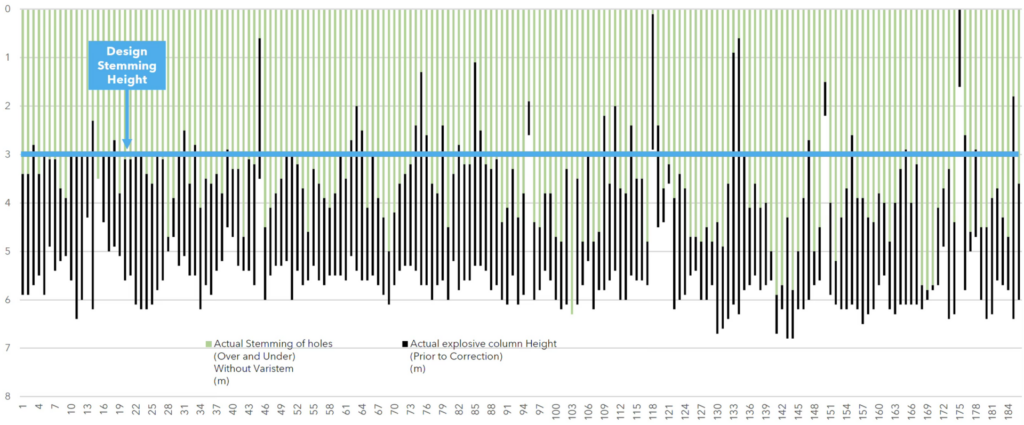
The in-field final stemming length measurements shown in Figure 1 revealed on average:
- 61% of holes were undercharged (>3.3m stemming column).
- 13% of holes were overcharged (<2.7m stemming column).
- 26% of holes were within a 10% deviation from the design (stemming column between 2.7m and 3.3m).
- When looking at the undercharged holes in isolation, the average stemming column height was 4.19m (39.67% longer than planned).
- When looking at the overcharged holes in isolation, the average stemming column height was 1.8m (40.00% shorter than planned).
The above can result in some significant blast outcome challenges, as illustrated in the bench plan layout in Figure 2 (note only severely undercharged and overcharged holes were included in the illustration).
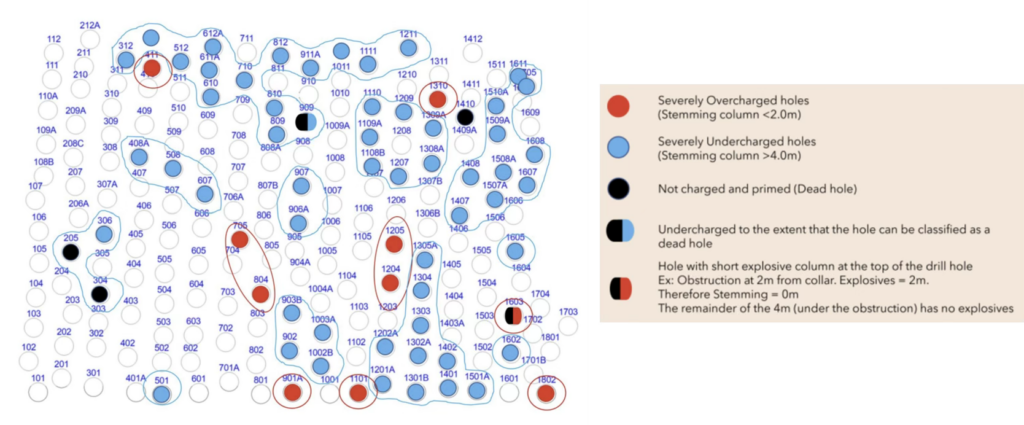
Problem Hypothesis
As shown in the outcomes of the QAQC exercise on Bench A, the conformance to design was poor (with only 26% of holes charged to within a 10% deviation or less to the design). The remainder of the holes were undercharged (61%) and overcharged (13%).
From ERG Industrial’s experience in working with other sites, in the vast majority of cases the problem area is with overcharged holes and not undercharged holes. The fact that 61% of holes were undercharged may point to a larger fundamental root cause being responsible for this, and not necessarily poor discipline.
It can either be that the blasting bench had a large degree of pre-existing fractures (resulting in run-aways), or it could be that the charge design used the drill bit diameter of 127mm as an input and not the effective callipered hole diameter. In the case of the prior, the solution would be to sleeve the holes before charging. In the case of the latter (which is more likely the culprit), the solution would be to calliper holes when drilling starts on the next bench, and to use this callipered diameter as a charge design input.
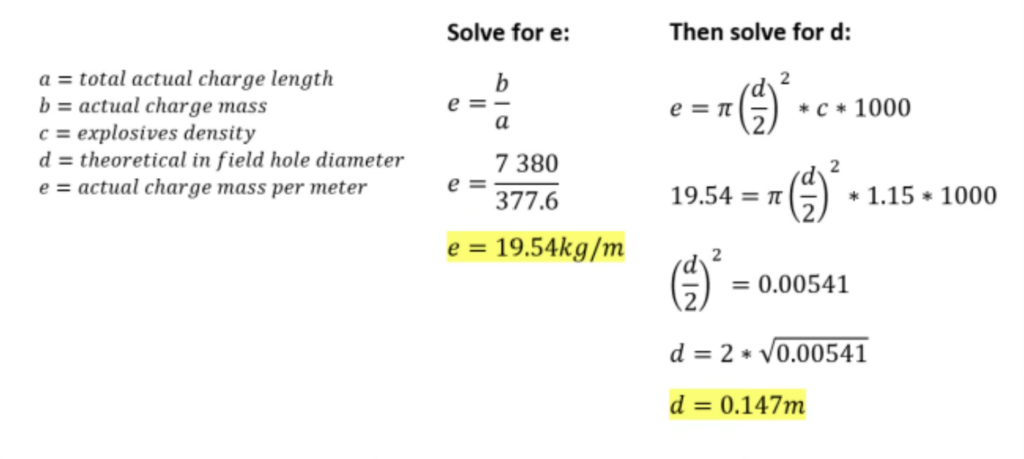
For illustration purposes, a theoretical calculation was done to answer the question of “what was the theoretical in-field hole diameter based on the total charge mass and charge length?”
This calculation is shown Figure 3, producing a theoretical in-field diameter of 0.147m. It must be noted that this is not necessarily what the actual in-field diameter was for drilled holes. The calculation assumes zero run-aways, and it is likely that there was some degree of run-aways on the block, which would then mean that the actual in-field diameter would be smaller than 0.147m.
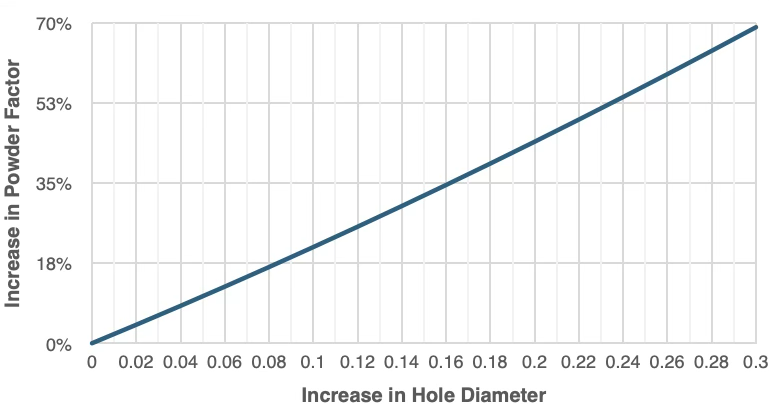
To understand the consequences of the in-field diameter differing from the bit diameter, a reference diagram was produced to indicate how the powder factor is impacted by an increase in hole diameter. Figure 4 shows the reference diagram. The theoretical in-field diameter of 147mm represents a 15.75% increase in hole diameter (from an original bit diameter of 127mm) and translates to an estimated increase in overall powder factor of a staggering 35%.
Hole Callipering Results
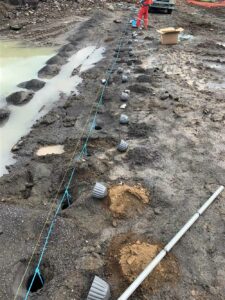
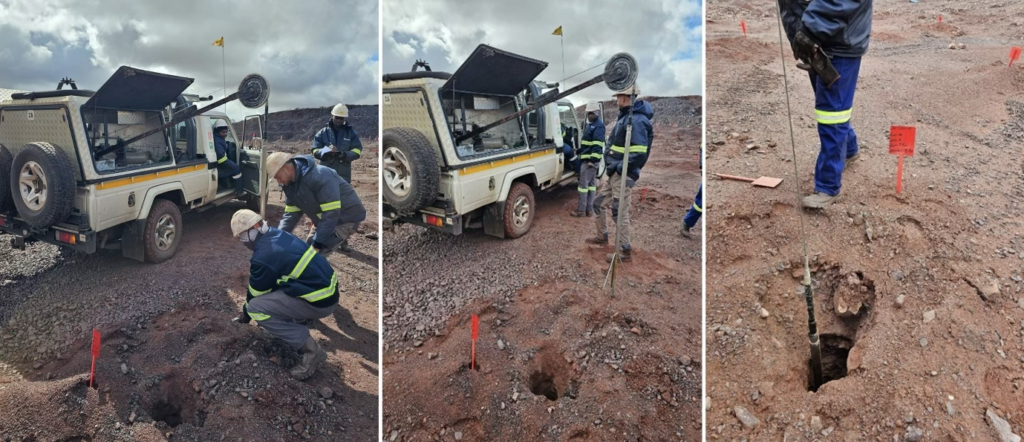
As a result of the independent QAQC findins, a hole callipering exercise was commissioned to obtain accurate measurements of the actual in-field hole diameters. Figure 5 shows the hole callipering in action and Figure 6 shows the results from the measurements taken.
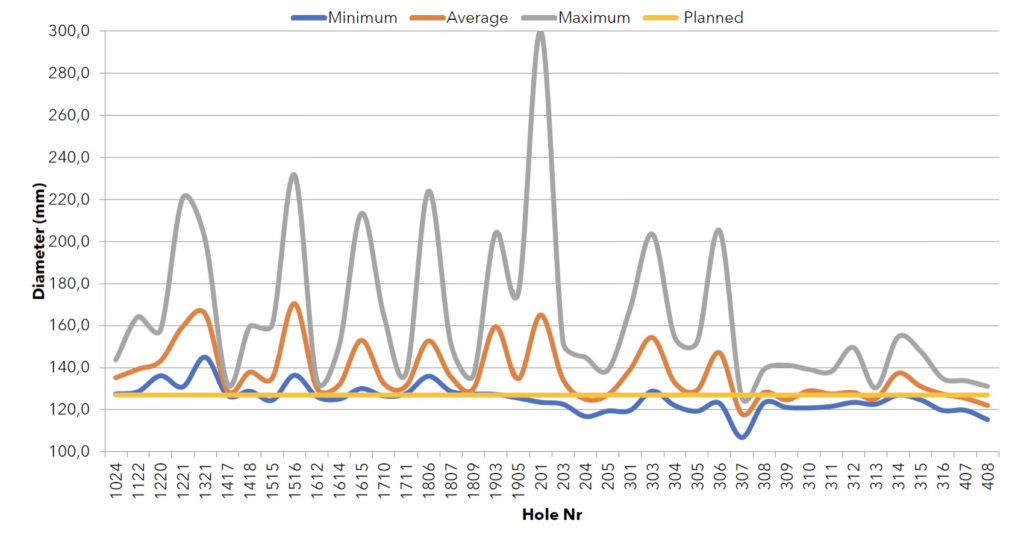
A summary of the results shown in in Figure 6 are as follows:
- An average hole diameter of 142mm was measured (in comparison to the 127mm in the design).
- This correlates to the 147mm theoretical in-field diameter that was calculated, showing that the large number of undercharged holes were as a result of the larger in-field diameter and not exclusively attributable to operator and or execution issues.
- This change in hole diameter has a significant impact (+25%) on the charge mass per meter, increasing from 14.57kg/m (at 127mm diameter) to 18.21kg/m (at 142mm diameter).
CONCLUSIONS
- Iron Ore Mine X historically made use of their chosen drill bit diameter of 127mm as an input in their drill and blast design.
- During the design process, Iron Ore Mine X produces explosives charge sheets, indicating how many kilograms of explosives need to be charged into each hole on a given blast bench.
- An in-field QAQC exercise was performed where actual final stemming lengths (after charging) were measured.
- This was compared against the design final stemming length of 3m, revealing a gross mismatch between the design and the actual, notably 61% of the holes being undercharged. This pointed to a larger root cause problem.
- It was hypothesised that the gross mismatch could be as a result of the effective in-field diameter of the holes being larger, on average, than the drill bit diameter. A theoretical calculation was done using the discrepancies picked up during the QAQC exercise, resulting in a theoretical in-field diameter of 147mm (as compared to the design diameter of 127mm).
- A reference chart was produced, showing an alarming relationship between an increase in hole diameter and the corresponding increase in powder factor (e.g. a 20% increase in hole diameter results in a 44% increase in powder factor).
- A hole callipering exercise was then done, resulting in the collective measurements showing an average in-field diameter of 142mm (as compared to the design diameter of 127mm).