Velocity of Detonation (VoD) is a technical term in the blasting and explosives domain. It refers to the speed at which the explosive shock wave propagates through an explosive material following initiation, measured in meters per second (m/s) or feet per second (ft/s). The VoD of an explosive is influenced by several factors, such as:
- The chemical composition
- Density and
- Confinement characteristics of the explosive material
Consideration of the VoD of an explosive plays a critical role in ensuring the safety of blasting operations. It helps as a design input for the timing and sequence of initiation, ensuring that the detonation wave progresses as intended and that adjacent charges detonate in a controlled fashion. By understanding and managing the VoD, the risk of unwanted events such as misfires, premature detonations, or erratic blasting outcomes can be minimised.
The VoD also influences the particle size distribution of the resulting post-blast muckpile. High VoD explosives tend to produce finer fragmentation, while lower VoD explosives may result in larger rock fragments. Understanding these effects assists in optimising blast designs to achieve desired fragmentation outcomes for efficient downstream processing.
Case study
Copper Mine X in Africa was looking at initiatives to improve explosive efficiency, with an increase in VOD being one of the desirable outcomes. Through research methods, Copper Mine X’s team identified Varistem® stemming plugs as a potential tool to assist with the larger goal of improving explosives efficiency.
Hypothesis
The hypothesis was that the use of Varistem® stemming plugs in the drill and blast design would result in an increase in VOD due to improving explosives confinement or energy retention.
Methodology
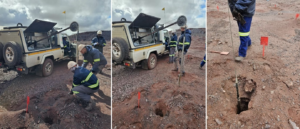
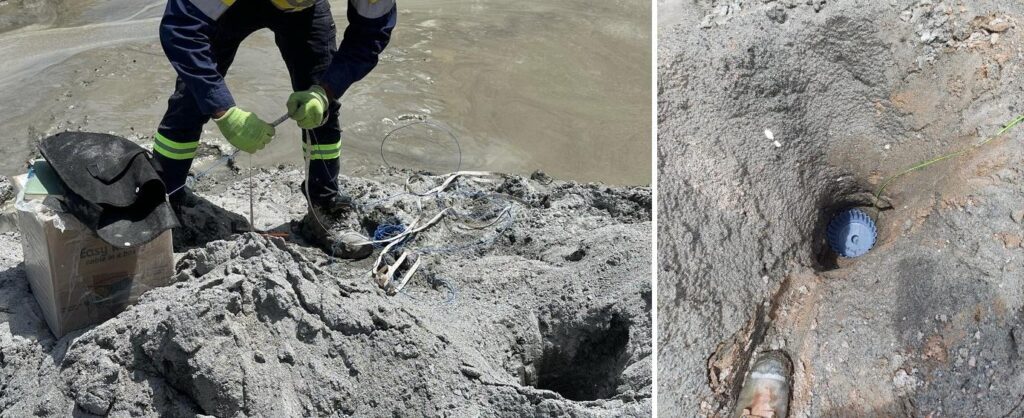
A simple test was designed to investigate the aforementioned hypothesis. A normal production blasting bench was selected for the test, whereafter ten (10) holes were selected to form a part of the VOD testing. Five (5) holes with VOD traces would then use Varistem BP8 stemming plugs (for 203mm holes) in combination with conventional stemming material, and five (5) holes with VOD traces would use only conventional stemming material.
Results
The VOD results obtained from the trial blast are shown in Table 1. Although one of the holes did not record a trace, the results demonstrate consistency with a low standarddeviation. On average, the VOD of the holes with Varistem® stemming plugs was 10.9% higher than that of those without. This represents a remarkable improvement as a result of a simple and inexpensive change.
Table 1: VOD comparison – Holes with Varistem and Holes without Varistem
| VOD #1 (m/s) | VOD #2 (m/s) | VOD #3 (m/s) | VOD #4 (m/s) | VOD #5 (m/s) | Average | |
| 203mm with Varistem® | 5 632 | 5 529 | 5 546 | 5 658 | No trace | 5 591 |
| 203mm without Varistem® | 5 062 | 5 021 | 5 088 | 4 990 | 5 038 | 5 040 |
Conclusions and recommendations
Copper Mine X wanted to improve explosive efficiency, focusing on (amongst others) initiatives to increase the VOD of the explosives used on site. Varistem® stemming plugs were selected as a potential technology to improve explosive energy confinement, which in turn could increase the VOD.
Copper Mine X designed and executed the VOD trials, registering 9 out of 10 traces and producing a result that indicates a VOD increase of 10.9% when Varistem® stemming plugs are used.
Although the data strongly infers that the improvement is as a result of the Varistem® stemming plugs, it is recommended that further trials of a similar nature be conducted to ensure that the outcomes achieved in the initial trial are repeatable.