
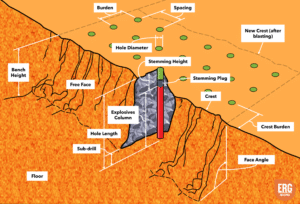
High-Level Blast Design Basics
Designing a blast involves the consideration of multiple parameters, and achieving the desired blasting outcome necessitates a thorough understanding of the interplay and interdependence of
When a blast loses energy up the blast hole, the cost shows up downstream. Coarser fragmentation slows the crusher and drives up the cost per tonne. Wasted explosives and extra drilled metres erode the profit margin of every hole. The device you choose to hold that energy in the hole shapes how productive and controlled each blast becomes.
We compare Varistem and Paraplug across the factors that determine on-site performance. That means what they cost, which hole diameters they fit, how they work with your explosives, how their mechanisms differ, and what results each product can show.
Varistem is priced by hole size, starting at roughly US$1 for the smaller plugs and rising to about US$16.13 for the largest. Because you only buy the size a given hole calls for, the cost per hole stays consistent even when a pattern mixes several diameters. The pricing is public and tied directly to diameter, so it can be costed accurately while the blast is still on paper.
Paraplug does not publish a price list, as it is sold on a quote-and-free-trial basis. Per-hole cost cannot be established at the planning stage without contacting the supplier directly, which makes upfront comparison and blast-pattern budgeting more difficult than with a published, diameter-based structure.
It is a mechanical blast-hole plug that can be repositioned if placed incorrectly before firing. A crew that seats it at the wrong depth or gets a bad grip can correct the placement instead of losing the unit or accepting a sub-optimal deck.
The difference between these products is cost certainty versus cost that depends on execution. With Varistem, you can lock a firm per-hole figure into the blast plan and forecast spend across the entire pattern before you drill, keeping budgets and tenders accurate.
Paraplug’s pricing can only be confirmed by quote, so its economics only work in your favour if the promised explosive and drilling savings land. For predictable cost, Varistem is a safe bet.
Varistem covers blasthole diameters from 1.75″ (45 mm) up to 10″ (251 mm). Each plug in the range is built for a specific diameter window rather than a broad band, so the fit stays tight across the full lineup and suits the majority of standard production holes.
Paraplug is offered in set disc sizes rather than a fine diameter ladder. Standard sizes are 171mm, 200mm and 251mm, with additional sizes available on request, including 172mm, 197mm, 230mm, 250mm, 270mm and up to 312 mm.
The range does not extend to the smaller production holes that diameter-specific plug ladders reach. Ensure that your team confirms the correct size for a given hole with the supplier.
Fit is what turns into results in any blasting field. Varistem’s dedicated sizes across a defined 1.75″ to 10″ (45 to 251 mm) range mean each plug seats tightly in the correctly sized hole, so you get consistent confinement and fragmentation.
Paraplug is offered in a set of disc sizes from 171mm up to 312mm rather than a fine diameter ladder, so it covers fewer, coarser steps and does not reach the smaller production holes. For a tight fit across a wide range of hole sizes, Varistem’s smaller size steps make it easier to match a plug to each hole, while Paraplug suits operations working with larger diameters.
Varistem pairs with all commonly used commercial explosives, including ANFO, emulsions, heavy ANFO, and water gels. As usual, the choice comes down to hole conditions and site practice, with ANFO working well in dry holes and emulsion or water gel the better option once water is present.
Paraplug does not publish an explicit explosive-compatibility statement. As a mechanical air-deck device that sits within the column rather than reacting with the charge, it is effectively explosive-agnostic, and its reported trials use bulk blends such as heavy ANFO and emulsion.
Its main stated benefit is that it prevents contamination of the explosive column by stemming material. As a fully submersible device, it can be deployed in dry holes, static or dynamic water, and flooded holes without any additional tools.
The important factor with explosive compatibility is whether the charge performs as intended in the conditions you drill into. Varistem’s clear dry-versus-wet guidance means crews put the right explosive in the right hole, so water does not desensitise the charge and fragmentation stays consistent shot to shot.
Paraplug offers submersibility and a contamination-free seal in wet and flooded holes, protecting the column and allowing air-decking to cut the explosive load per hole, which lowers costs where water would otherwise force compromises. For dependable results across mixed dry and wet conditions, Varistem gives more direct guidance, while Paraplug earns its place where water is the dominant problem.
Varistem is built from a flexible, tear-resistant dip-moulded body. When the charge fires, the leading shock wave drives the plug up into the stemming, forming a brief pressure seal inside the blasthole. That seal channels energy into microfractures in the rock before the plug itself breaks, giving stronger early confinement, cleaner fragmentation, and more of the explosive energy doing useful work in the rock.
Paraplug is a purely mechanical, conic folding disc that is lowered to the required depth and pulled to lock against the blasthole wall, creating an air deck in the explosives column. The cone acts as a wedge that forces more detonation energy into the rock rather than up and out of the hole, described as a “blocked cannon” effect. It arms in under 20 seconds, needs no loading poles or tools, and is fully submersible.
The mechanisms are built for different payoffs. Varistem seals the collar and captures the initial shockwave energy, so you improve fragmentation and cut flyrock, noise and airblast on your existing charge design without reworking the blast.
Paraplug opens an air deck in the column, so its return comes from using less explosive per hole and trimming sub-drilling, provided the charge is redesigned around the deck and the device is placed accurately. In short, Varistem improves blast quality with minimal changes to how you load, while Paraplug pursues consumable savings at the expense of a complex setup.
Varistem’s results are backed by independently verified case studies across a range of site types. At one underground platinum mine, advance per blast rose from 2.46 m to 2.82 m, a gain of about 11%, and the case study tied to that trial estimated an annual net benefit of R1.91 billion from improved ore recovery.
Further documented outcomes span up to 80% less flyrock, an 87% improvement in cast, crusher throughput up more than 14%, loading rates up to 8% faster, over US$10 million a year in added value, and around US$1.45 million saved through fewer waste blasts.
Paraplug results are reported by the manufacturer and its customers. Vendor data cites savings of around 33% in explosives consumption and about 14.2% fewer drilled metres (per one million bank cubic metres), alongside improved fragmentation and reductions in flyrock, noise and vibration.
Paraplug states these gains over conventional stemming, though its own materials provide an inconsistent baseline of either gravel stemming or no stemming plug. No independently verified, mine-specific case studies are published alongside these figures.
Varistem’s gains are independently verified and quantified in monetary terms, so you can point to roughly 11% more advance per blast, an estimated R1.91 billion in annual net benefit at one platinum mine, and up to 80% less flyrock when you need to justify the switch to management or a client.
Paraplug’s 33% explosives and about 14% drilling savings would be attractive if they held, but they rest on vendor and customer reports without independent verification, so the operation carries the risk of proving them on site. If you want results you can bank on before committing, Varistem gives a better-evidenced case.
Varistem is the pick when you want a simple, cost-effective stemming solution with a documented track record and transparent performance data. It spans blasthole diameters from 1.75″ to 10″ and works with the full range of standard commercial explosives.
The plugs drop straight into the hole, with no special loading equipment required. That makes Varistem a strong fit for operations that value proven results and predictable costs for every hole.
Choose Paraplug when your priority is air-deck blasting in open-pit operations, and tool-free deployment is an advantage. It suits sites focused on cutting explosive consumption and eliminating sub-drilling through air decks placed at any depth, and where a mechanical device that avoids stemming contamination is valued, even though its pricing is quote-based rather than published.
Both plugs improve blast efficiency, but they solve different problems. Varistem is a collar-sealing stemming plug with transparent, diameter-based pricing, a defined 1.75″ to 10″ size range, and independently verified results, a strong default where predictable per-hole cost, precise fit and documented gains matter.
Paraplug is a specialist air-deck device that excels in wet and flooded holes and in reducing explosive use and sub-drilling, but it is sold on a quote basis with no published pricing and relies on vendor-reported performance. For most operations wanting budgetable performance across a range of hole sizes, Varistem offers what is needed. Paraplug is worth considering where air-decking in difficult, water-affected holes is the main objective.
ERG Industrial offers in-depth advice on stemming plugs and other blasting equipment. Contact us for a quote to see how your blasting team can benefit from Varistem.
Designing a blast involves the consideration of multiple parameters, and achieving the desired blasting outcome necessitates a thorough understanding of the interplay and interdependence of
Velocity of Detonation (VoD) is a technical term in the blasting and explosives domain. It refers to the speed at which the explosive shock wave
In our business, we are in a unique position where we get to spend time at countless sites, working with drillers and blasters during the planning,